

Lately, I have found that much of the conversation about AI focuses on technology – the tools, the models, the capabilities and the speed at which they are advancing. And with no surprise, the latest findings from the Coursera and Udemy Global Skills Report for 2026 show that interest in AI continues to accelerate.
Learners are now enrolling in generative AI content at a combined rate of more than 45 enrolments per minute, up from 25 per minute just one year ago, while overall AI enrolments have grown by 67% year on year.
Yet some of the report’s most interesting findings point somewhere else.
Alongside this rapid growth in AI learning is a significant increase in demand for capabilities such as critical thinking and judgment, ethics and governance, complex problem-solving, stakeholder alignment and influence, and leadership. Critical thinking enrolments increased by 107% year on year, while complex problem-solving grew by 126%.
That should make us all pause. It certainly makes me pause.
Because perhaps the defining challenge of the AI era is not helping people access intelligence. It is helping people exercise sound judgment when intelligence is readily available.
When Intelligence Becomes Abundant
For most of modern business life, access to information has been a constraint. Proper analysis always took time, and expertise was scarce and often expensive. Decision-making has been limited by what people knew and how quickly they could learn it.
It is clear that AI is definitely changing everything.
Increasingly, information, analysis and recommendations are now available on demand. Yet while AI can synthesise data, generate options and identify patterns with extraordinary speed, it still cannot be accountable for the consequences of the decisions that follow.
As IBM observed nearly fifty years ago, “A computer can never be held accountable, therefore a computer must never make a management decision.” While the technology has changed a lot since then, the underlying principle remains the same. AI CAN inform decisions, generate options and provide recommendations, but accountability still rests with people.
Humans remain responsible for deciding what matters, weighing competing priorities, managing risk, navigating ambiguity and acting with integrity.
Perhaps this helps explain why critical thinking now sits at the top of the report’s human skills rankings. The report defines critical thinking and judgment as the ability to evaluate evidence, question assumptions, recognise limitations and reach reasoned conclusions.
These are not simply cognitive skills – they are leadership capabilities.
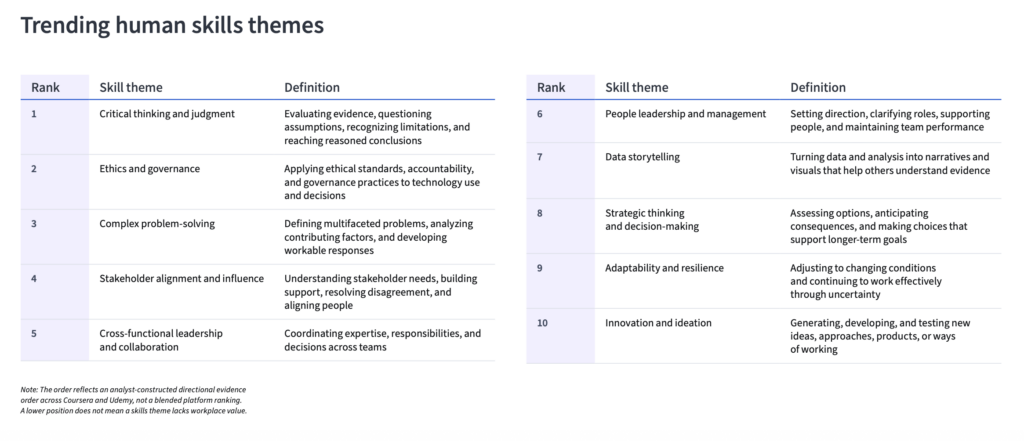
The report itself points to this connection, identifying critical thinking and judgment, ethics and governance, stakeholder alignment and influence, and strategic decision-making as some of the most important capabilities emerging alongside AI adoption.
In many ways, the more intelligence becomes available, the more important judgment becomes.
Leadership Beyond Leadership Roles
What is particularly interesting is that the report suggests these capabilities are increasingly being expected well beyond traditional leadership roles.
Research cited in the report found that 52% of newly acquired skills in AI-exposed entry-level positions were traditionally associated with more senior roles, including strategic decision-making, stakeholder management and people leadership. The report concludes that…
“individual contributors must develop leadership skills long before they take on formal leadership roles.”
This may be one of the most significant shifts happening beneath the surface of the AI conversation.
For many years, leadership development was largely viewed as something that occurred later in a person’s career, once they began managing teams or took on formal authority. Yet the nature of work appears to be changing in ways that require leadership capabilities much earlier.
If AI enables individuals to take on broader and more complex responsibilities, then responsibility expands alongside capability. More people need to make judgment calls. More people need to influence outcomes. More people need to work across boundaries and navigate competing stakeholder interests. More people need to decide not simply whether something can be done, but whether it should be.
In other words, AI may not be reducing the need for leadership at all, as we have noticed that it may be expanding it. Not leadership as a position, but more as a practice.
The expectation to think critically, influence effectively and make sound decisions is no longer confined to those with leadership titles. Increasingly, we are seeing it becoming part of everyday work.
A Different Question for Organisations
The report also found that learners are increasingly building AI and human skills together, with some of the strongest skill pairings connecting AI capabilities to innovation, critical thinking, decision-making and stakeholder alignment.
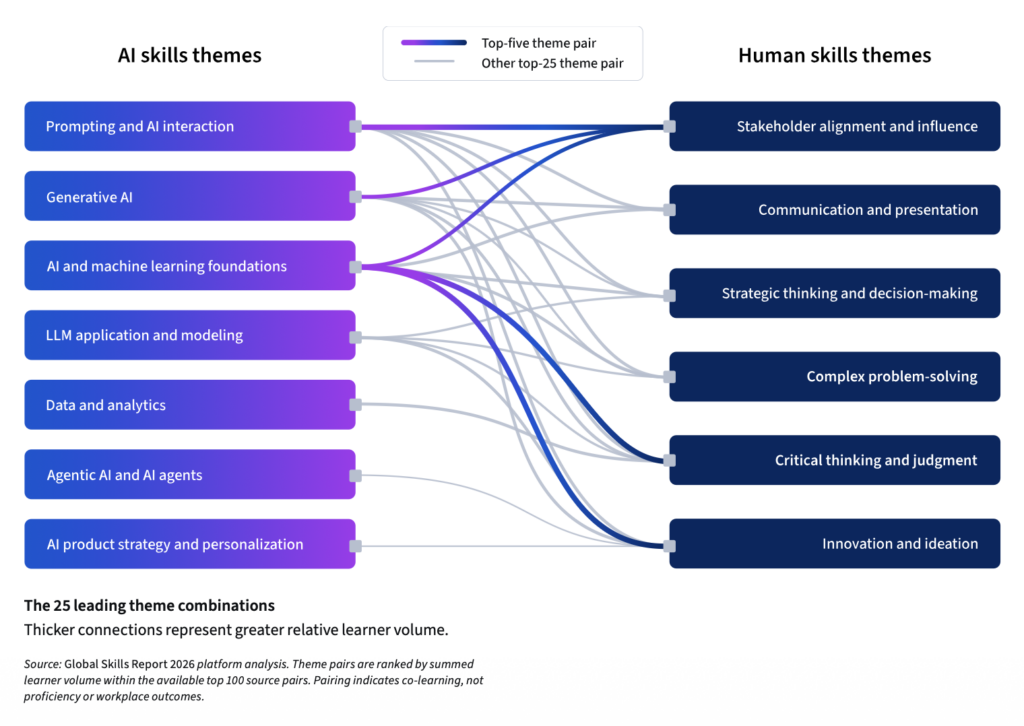
That finding feels important because it challenges the idea that developing AI capability and developing people capability are separate conversations.
The organisations that create the greatest value from AI are unlikely to be those that focus exclusively on tools. Rather, they may be those that invest equally in the human capabilities required to apply those tools wisely.
As the report notes,
“Realising value from AI requires both technical proficiency and human capabilities, such as critical thinking, complex problem-solving, and ethics.”
Perhaps this points to a different question for organisations.
Rather than asking only, How do we teach people to use AI?, we might also ask, How do we develop the human capabilities required to use AI responsibly, effectively and accountably?
Because while AI may transform how work gets done, leadership remains the capability that determines what gets done, why it matters and whether the outcome ultimately creates value.
That feels less like a technology challenge. And a lot more like the leadership challenge of the AI era.
Continue the Conversation
If AI is increasing the importance of judgment, influence, critical thinking and accountability, then leadership development may be more important than ever.
At Dattner Group, we’re exploring what leadership capability looks like in an AI-enabled world, and how organisations can help people develop the human skills that technology cannot replace.
To discuss leadership, learning and capability development in your organisation, just reach out.
Download the Report
Read the full report and let us know what you think?