
Trust Has Become a Leadership Issue
I’ve spent a lot of time lately sitting in rooms, boardrooms and exec team offsites. I’ve been listening to the quieter conversations that happen after the formal meeting has ended. What I continue to notice, underneath all the words being said, is a kind of low hum of weariness and wariness, a not infrequent sadness that nobody quite trusts anybody the way they used to.
We know it and feel it, but our day-to-day busyness might be numbing us to its cause and effect. With help, in the offsites we run, they find a rhythm, and a sense of belonging. Then they say, ‘but come Monday’, with the best will in the world….
The 2026 Edelman Trust Barometer gives shape and number to the reality that trust has stopped being a reputational nicety and is, instead, the very thing that determines whether people choose to engage with an organisation at all.
Trust informs whether they buy, whether they stay, whether they believe what they’re told, or whether ‘they’ are all a pack of lying bastards.
We have known for a long time that trust is the building block of alignment – in families, communities, businesses and governments. Where we trust one another, we have empathy. Where we have empathy, we are more likely to collaborate, and develop win-win solutions.
It is hard to build, and brutally easy to damage. It matters more to us now and it is seemingly harder to earn.
Why are we only trusting people who look like us?
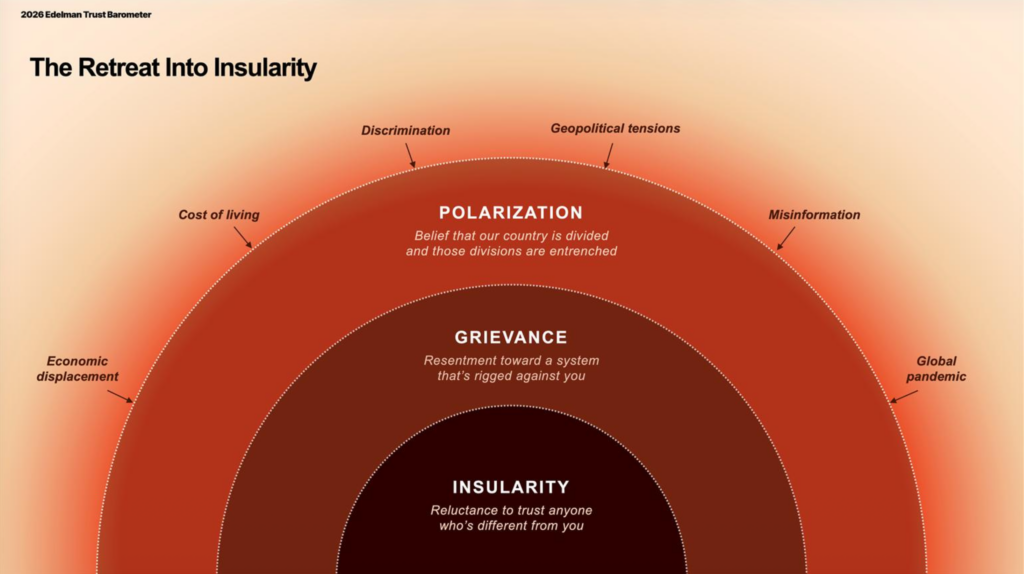
One of the report’s findings stayed with me longer than the others, which is the extent to which people are retreating into familiarity and sameness, reserving their trust for those who appear to share their beliefs, their experiences, their worldview, while treating anyone or anything unfamiliar with a kind of quiet suspicion.
It would be easy to assume this is a phenomenon confined to public discourse, to the noisier corners of politics and social media. But that would be naïve, because it walks in through the front door of every organisation, every single day, carried in by the people who work there. It comes and goes in families and friendship groups, raising its ugly intolerant head in surprising circumstances (normally at times of births, deaths and marriages).
What Happens in Society Happens in Organisations, Including the Ones We Ask to Serve Us
I think this is especially true, and painful to watch in local government and the broader public sector. Councils, in particular, seem to be caught in a bind not entirely of their own making. They’re trying to serve increasingly polarised communities, trying to hold budgets together under enormous public scrutiny, trying to make long-term decisions in an environment that rewards short-term outrage, and finding that the very trust they need to govern well is the thing draining away fastest. Adding salt to the wound, this often happens for reasons that have very little to do with the actual quality of their decisions, and everything to do with a wider general erosion of faith in institutions.
Polarisation changes how teams collaborate, distrust changes how people interpret a decision, and uncertainty changes the way employees, or ratepayers, or citizens, engage with the people meant to be leading them.
The consequences tend to be subtle, showing up first as caution, then as conversations that lose their honesty. Then they show as disagreement that happens in the public domain or online, until eventually the whole culture, public or private, has quietly reorganised itself around self-protection, and lie and truth are indistinguishable.
Most leaders respond to this by communicating more, by producing clearer statements, more detailed reports, more forums for explanation, hoping the data will resolve the conflict.
I understand the impulse completely, but sadly, I have never seen trust rebuilt through fact alone. It’s just your data over mine and what comes to mind is that awful response when people are challenged: ‘well I’ve done my research and…’
Despite a radical difference in source of information, my opinion over decades of validated research have become the same, equally valid. I am now entitled to my facts as well as my beliefs.
Is Trust Something You Announce, or Something You Earn?
Trust is built over time, through consistent behaviour – mine and yours.
It grows when people experience leadership that is consistent and fair, even when nobody is watching closely, when difficult conversations are had rather than managed around, when leaders show a genuine curiosity about the people who see things differently and make room for them anyway.
It grows, too, when institutions – business, government departments, or councils demonstrate trustworthiness through their actual conduct over time. We come to rely on these bodies and we believe they will do what they said they would do.
You cannot declare trust exists, no matter how well you write the press release.
Rebuilding Trust Requires Different Leadership
Over more than three decades of working alongside leaders across business, government and the public sector, I have come to believe that organisations, councils very much included, rarely suffer from a trust problem in isolation.
What looks like a communications failure or a policy failure is very often, underneath, a set of old leadership assumptions, tired organisational habits and quietly eroded relationships that have been accumulating for years before anyone thought to name them.
In these circumstances, a new system will not save you, and neither will a new structure or a redesigned process, because none of that addresses the human dynamics sitting at the centre of the problem.
What’s required instead are leaders capable of listening deeply, sitting inside genuine difference without flinching, navigating conflict rather than avoiding it, and being honest with themselves about the impact of their own behaviour on the people they lead.
This is not easy work, and it demands courage, humility and a genuine willingness to question long-held assumptions about authority and leadership and what organisational success is even meant to look like. But it is precisely this work, unglamorous and slow as it is, that allows trust to take root and grow.
Trust Is Built Through Leadership
The Edelman findings shouldn’t be filed away as another set of data points to reference in a slide, but taken instead as an invitation to reflect, properly, on what kind of leadership you are actually practising.
The question was never whether trust matters. That’s settled.
The real question is whether you are willing to do the leadership work trust actually demands, in your organisation, your council, your team, your own family. At Dattner Group, this sits at the very centre of what we do, whether we are working with an executive team, developing leaders in cohorts, strengthening culture, or helping an organisation navigate genuinely complex change.
Our focus remains on creating the conditions in which trust can emerge, and grow, and hold. We are mindful that the people watching – friends, family and colleagues – often expect inconsistency because it’s a safer bet. They won’t be disappointed when things don’t go as we had hoped.
But when trust goes, a lot leaves with it – belonging, care, calm, shared humour, co-creation, self-awareness, safety, courage, compassion and love.
It’s a terrible price.
Want to close the trust gap in your organisation? Dattner Group works with leadership teams to build the capability that turns decisions into shared understanding, not just announcements. Get in touch with Dattner Group to talk through what this could look like for your team.