


Every organisation working toward genuine, lasting change tends to run into the same blocker eventually.
The strategy has been carefully built, the targets are clear, and the systems are all in place, yet somehow the change itself doesn’t take hold in the way everyone hoped it would.
More often than not, the missing piece isn’t external at all. It lives inside the leader, in their capacity to carry complexity and uncertainty while still staying present to what others are experiencing.
This is the thinking behind the Inner Development Goals, or IDGs, a framework created in 2020 by a global collective of researchers and practitioners who noticed something the world’s Sustainable Development Goals had largely left unaddressed.
What are Inner Development Goals?
If there are 17 SDGs describing the change we want to see in the world, what are the inner capabilities leaders actually need in order to bring that change about?
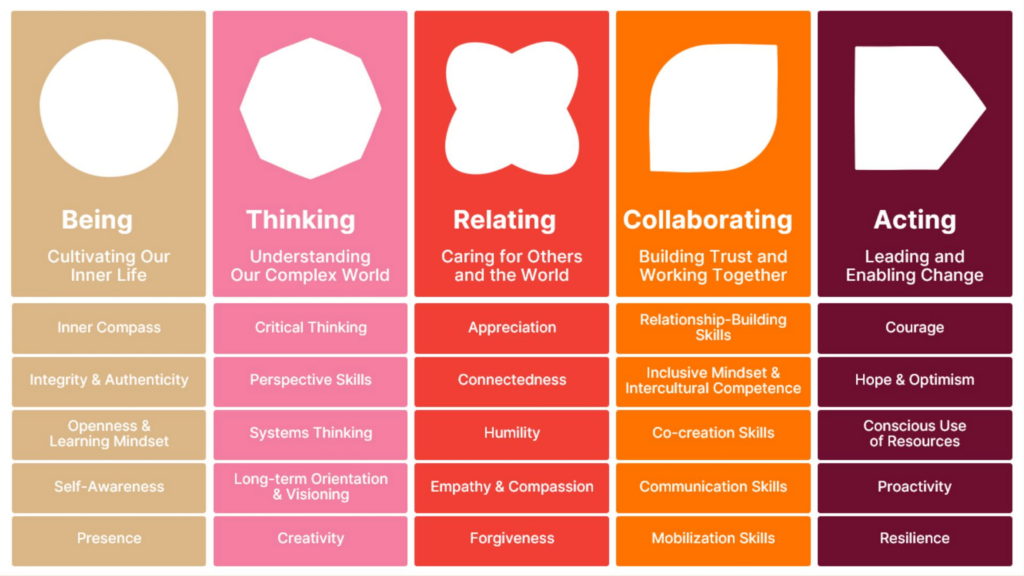
Their answer became 23 skills and qualities, organised into five dimensions: Being, Thinking, Relating, Collaborating and Acting.
- Being describes a leader’s relationship with themselves, their presence, their self-awareness and the inner compass that steadies them when things get hard.
- Thinking is about how a leader makes sense of complexity, holding critical thought, multiple perspectives and a genuine long-term view all at once.
- Relating speaks to how a leader holds space for others, with appreciation, connectedness and enough humility to stay open to being wrong.
- Collaborating is the capacity to work well with people who see the world differently, built on trust, honest communication and a mindset that welcomes rather than tolerates difference.
- Acting is where insight becomes movement, carried by courage, perseverance and a steady, well-earned optimism.
These aren’t soft skills, sitting off to the side. They’re the foundation everything else is built on. It is the operating system that a leader does depends on.
Why This Matters Now
Most leadership development still moves from the outside in. A skill is taught, a workshop is run, a model is handed over, and it works well enough until the pressure arrives. Then the old patterns quietly resurface, because the inner capacity to hold complexity under strain was never built in the first place.
The IDG framework asks us to work in the other direction, building the inner capability first so the outer skills have something solid to stand on when it matters most.
This feels particularly relevant for anyone leading through uncertainty, dealing with competing priorities, and navigating constant change.
How Leaders Can Use This
The framework is not another program to add to an already full plate. It’s better understood as a lens, and a genuinely useful one, for looking at how you lead. There are a few ways to begin.
Start by looking honestly, rather than aspirationally, at where you sit across the five dimensions. Most leaders already have a sense of where they are strong and where they quietly avoid discomfort. Naming it, even just to yourself, is often the hardest and most useful step.
Resist the urge to work on everything at once. Choosing two or three qualities that matter most in your current context, and staying with them for a while, will take you further than skimming across all 23.
Let the work live in small, repeated moments rather than a single offsite. A ten minute pause before a difficult conversation, or a genuine question asked instead of a quick answer given, does more over time than any single workshop.
Pay particular attention to Relating and Collaborating, since these are often where leaders overestimate themselves most. A trusted colleague who can tell you honestly how you show up under pressure is worth more than any self-assessment.
And treat Acting as the outcome of the other four dimensions, not the starting point. Courage and perseverance without a grounded inner foundation tend to burn people out rather than sustain them.
The Bigger Picture
Sustainability, culture change and lifted capability all depend, in the end, on leaders who have done this quieter work first. The IDGs offer a shared language and a practical structure for that work, rather than leaving it to chance, charisma or good intentions.
Big change, little by little, really does start on the inside.
If you’re wondering what this might look like for your own leadership team, we’d love to talk it through with you. Get in touch with Dattner Group to explore how the Inner Development Goals can be woven into your leadership development.