


Why leadership alignment — not more data — determines whether culture change succeeds in councils and complex organisations.
Many organisations reach a point where they have significant insight into their culture, yet change still feels difficult to sustain. This article explores why that happens, and where leadership attention makes the greatest difference.
Ten observations on leadership, evidence and culture change
Across our work with councils and complex organisations, several patterns appear consistently:
- More data rarely resolves cultural challenges on its own. Insight describes experience but does not automatically change behaviour.
- Recurring issues are usually systemic rather than local. Patterns often reflect how decisions, accountability and expectations move through the organisation.
- Organisations often know more than they think they do. The challenge is usually interpretation and alignment, not information gathering.
- Interventions struggle when leadership expectations remain inconsistent. Culture follows what is reinforced daily, not what is introduced periodically.
- Culture change begins where authority sits. Leadership behaviour shapes organisational norms whether intentionally or not.
- Variation in leadership practice creates fragmentation. People quickly learn which expectations are real and which are aspirational.
- Ownership is the bridge between insight and action. Shared responsibility for what the evidence implies is what creates movement.
- Change becomes sustainable when leaders ask more of themselves, not more of the organisation.
- Small shifts in leadership alignment often produce disproportionate organisational impact.
- Lasting culture change is less about new initiatives and more about consistent leadership practice over time.
Councils are evidence-based institutions by necessity
Councils operate in environments of high accountability and complexity. Public trust matters. Decisions carry long-term consequences. It is entirely understandable that organisations place strong emphasis on gathering information before acting.
Over time, however, many organisations reach a point where information feels abundant, yet direction remains unclear.
Engagement surveys have been run. Feedback has been gathered. Themes are known. Leaders are often deeply aware of where pressure sits. At the same time, people can begin to experience consultation fatigue, unsure how additional input will meaningfully change their experience of work.
The challenge is rarely the absence of information.
More often, the challenge is the quiet assumption that information automatically creates the next step, and that the next step must involve another intervention or initiative.
In practice, this is often the point where culture work begins to lose momentum.
Evidence is good at describing experience. It is not automatically good at explaining persistence.
Most organisational measures are effective at capturing what people are experiencing at a particular moment in time. They surface friction, dissatisfaction, and areas where trust may be under strain. This matters. It gives leaders a valuable view of the present.
But the question leaders are usually trying to answer is different:
Why do the same issues continue to reappear, even after effort, investment and good intent?
That question rarely yields to measurement alone.
Often what is required is not more data, but deeper interpretation — understanding the organisational patterns that continue to produce similar outcomes over time.
In one major regional council we worked with, substantial culture information already existed, including established assessments that made the gap between aspiration and lived behaviour visible. The organisation did not need additional evidence to understand where attention was required. What proved more valuable was connecting that evidence to the leadership system shaping daily experience, and translating insight into coherent action over time.
(See our culture transformation work with Broken Hill City Council.)
When the same issues recur, the causes are rarely isolated
Most councils can identify areas that consistently carry higher levels of strain. Operational environments. Highly dispersed teams. Workgroups with long histories or distinct subcultures. Places where leadership has often evolved through circumstance rather than deliberate design.
It is understandable to assume that if an issue appears in one part of the organisation, the solution must also sit there.
Sometimes that is true for an incident. It is rarely true for a pattern.
Across our work with councils, recurring pressure points often reveal broader organisational dynamics rather than isolated problems. What appears as a local issue can instead reflect how decisions are made, how accountability travels through the system, and what behaviours are implicitly reinforced or left unchallenged.
This dynamic is reflected in a number of publicly documented council engagements, including our work with Armidale Regional Council, where sustainable progress began once leaders examined the organisational conditions shaping people’s experiences, rather than focusing solely on presenting symptoms.
(Read our case study on culture transformation at Armidale Regional Council.)
When challenges resurface over time, the more useful question becomes not “what is wrong here?” but “what is the system making possible?”
Why isolated interventions so often fade
When pressure builds, the instinct to respond quickly is understandable. Organisations want to act. They want to demonstrate responsiveness and support.
However, when culture is approached primarily through episodic intervention, there is a risk that the underlying conditions remain unchanged.
Over time, the organisation can learn that culture challenges are something addressed temporarily rather than something shaped through everyday leadership practice. Improvement may occur briefly before familiar patterns gradually return.
For this reason, work that focuses only on isolated intervention often struggles to create lasting change. Targeted action can be valuable, but it becomes sustainable only when it sits within a broader leadership frame that provides consistency and meaning to the work.
In councils where progress has held over time, interventions have rarely stood alone. They have formed part of a wider shift in how leaders understand their role in shaping culture.
Culture change begins where authority sits
This is sometimes the most uncomfortable insight in culture work, and also the most hopeful.
Culture is shaped, deliberately or accidentally, by what leaders repeatedly signal is important: what receives attention, what is tolerated, what is prioritised under pressure, and what is consistently modelled.
If leadership groups do not share a clear articulation of the minimum expectations they intend to uphold across the organisation, variation becomes inevitable. Over time, variation can lead to fragmentation, and fragmentation to inconsistent experiences of work.
At some point in this work, attention inevitably returns to leadership.
In our work with councils including Armidale and Alpine Shire, progress began to hold when executive teams spent time articulating the culture they were intentionally shaping and aligning their own leadership practice around it. This was not about perfection or blame. It was about coherence. Once that coherence existed, work in specific business units became far more effective because it was no longer working against competing assumptions elsewhere in the organisation.
(See our work with Alpine Shire Council on purpose-aligned culture and leadership.)
Leadership shapes culture whether leaders intend it or not. The question is whether that shaping is conscious.
From evidence to ownership: where change actually begins
Many organisations are strong at collecting evidence and far less practiced at creating shared ownership for what that evidence implies.
The missing step is often not more evidence — it is shared ownership of what the evidence implies.
Ownership sounds simple until you try to do it.
Ownership means a leadership group can say, together and with clarity:
- This is the culture we are intentionally shaping.
- These are the minimum standards we will uphold across the organisation.
- This is how our own leadership practice must evolve to support that intention.
In councils where culture work has moved beyond cycles of activity and fatigue, progress has not come from asking people for more input. It has come from leaders asking more of themselves.
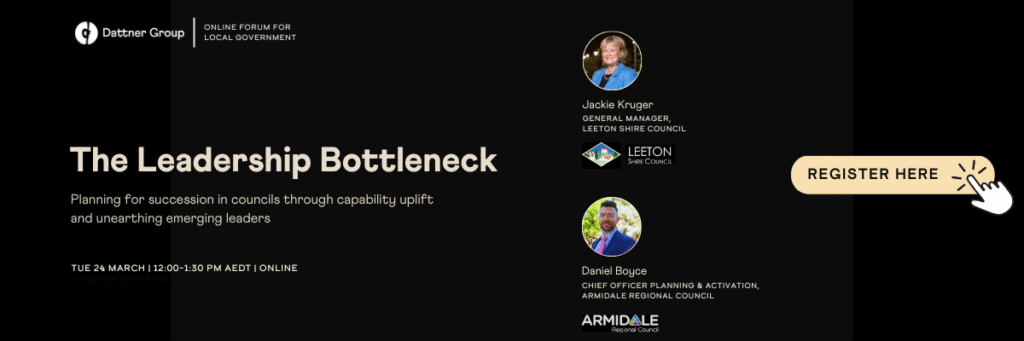
These questions are increasingly surfacing in conversations with council leaders across the sector. For those interested in exploring how succession, capability and leadership ownership intersect in practice, we will be continuing this conversation in an upcoming online forum for local government, The Leadership Bottleneck.
At Alpine Shire Council, for example, leaders connected existing engagement insights with a shared articulation of purpose, values and leadership expectations. The result was not a series of disconnected initiatives, but a clearer leadership frame that allowed subsequent work to be more coherent and sustainable.
What a disciplined next step in culture change can look like
When organisations feel saturated with input, the answer is not necessarily another large-scale diagnostic.
In councils that have made progress without adding to fatigue, the work has often followed a similar path:
- Use what already exists. Bring together existing evidence and interpret it as a system rather than isolated signals.
- Add limited qualitative insight. Conduct a small number of structured conversations that help illuminate how people experience the organisation in practice.
- Work at the leadership level first. Establish shared language, minimum expectations and alignment around leadership responsibility.
- Pilot inside a leadership frame. Targeted work becomes far more effective when supported by coherent leadership expectations and consistent practice.
This approach is not slower. In many cases it is faster, because it reduces the cycle of repeated initiatives that generate movement without durability.
A closing thought
Most councils do not struggle with culture because people lack commitment.
They struggle because the system itself is complex: dispersed services, competing priorities, operational demands and deeply held histories shaped over many years.
If you want a different culture, the starting point is rarely more evidence.
It is a different question.
What are we prepared to lead, together and consistently, so that the system cannot simply return to what it already knows?
That is where culture change begins. Not with more evidence.
With ownership.
Further perspectives on leadership and culture
This perspective draws on many years of practice alongside councils, as well as a broader body of leadership and organisational research.
John P. Kotter — Leading Change
A foundational perspective on why organisational change succeeds when leadership alignment and shared ownership precede implementation.
Bernard Burnes — Kurt Lewin and the Planned Approach to Change: A Re-appraisal
A revisiting of Lewin’s foundational work, emphasising that sustainable change depends on shifts in shared assumptions and leadership engagement, not process alone.
Oxford Review — The Essential Guide to Evidence-Based Organisational Change
An exploration of evidence-based change and the limits of data alone in producing meaningful organisational outcomes.
Adam Grant — Think Again: The Power of Knowing What You Don’t Know
Explores intellectual humility and the leadership capacity to rethink assumptions in complex and changing environments.
William Bridges — Managing Transitions: Making the Most of Change
A widely used framework distinguishing external change from the internal psychological transition people experience during change.