


Every year, organisations pause to celebrate International Women’s Day.
Breakfasts are hosted. Achievements are recognised. Commitments are renewed.
And then the day passes.
For senior leaders, the more valuable question is not so much how to mark International Women’s Day, but rather, is advancing women’s leadership structurally embedded in your organisation’s strategy?
At Dattner Group, this work sits at the core of how we think about leadership, culture, and organisational performance, not just in March, all year round.
Because the case for investing in women’s leadership should not be symbolic – it is strategic.
The External Context: Business Issue or Social Initiative?
1. The shrinking pathway to senior leadership
Australia has reached near gender parity in workforce participation, with women representing around half of all workers. Yet that balance does not carry through to senior leadership.
According to the Workplace Gender Equality Agency’s 2024–25 Gender Equality Scorecard, based on data from more than 8,000 employers:
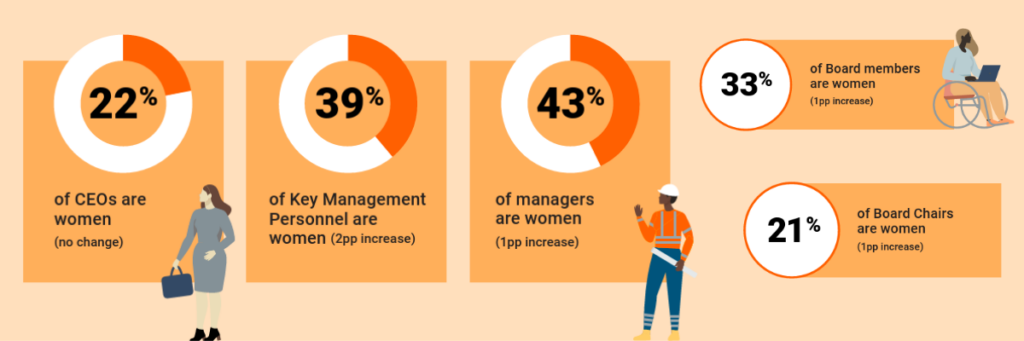
There’s a steady supply of women into organisations, but they’re not progressing to the top.
For boards and executive teams, this raises questions about course-correction in how you are building your talent pipeline. Without deliberate intervention, capable women stall or step away just before senior influence is realised.
The impact is practical and measurable:
• Reduced succession depth
• Weakened leadership continuity
• Loss of high-potential talent
• Diminished long-term organisational capability
2. Inclusion as a performance lever
The link between inclusion and performance is well evidenced.
McKinsey’s global Women in the Workplace series, including the latest 2025 edition, consistently finds that organisations with more women in senior leadership report stronger organisational health, more inclusive cultures, and better talent outcomes. That includes higher retention and promotion rates for women and other under-represented groups, outcomes that directly influence engagement and long-term performance.
The Credit Suisse Research Institutes: Gender 3000 in 2021 study similarly highlights that gender diversity in corporate leadership is associated with stronger financial performance, higher company valuations and improved stability. For investors and boards, diversity is not a social signal. It is a material factor.
Australian research reinforces the same pattern. Diversity Council Australia continues to link inclusive cultures with stronger engagement, innovation, wellbeing and intent to stay.
The message across these studies is consistent. Elevating the visibility and impact of women leading is a performance lever.
This shows up in the quality of decisions, the distribution of power, and the way leadership is practised each day. Progress cannot be delivered through policy alone. It is experienced in whose voice carries weight, whose ambition is encouraged, whose leadership is actively sponsored, and whose impact is recognised.
3. The wellbeing and ambition data reveals a leadership risk
An insights paper from GLWS: The Gender Wellbeing Gap 2025 and the Women’s Ambition Report show that women continue to report high levels of ambition, capability, and commitment. They also report elevated stress, burnout risk, and psychological load compared to men in comparable roles.
Do you measure wellbeing in your organisation as well as engagement or leadership capability?
You may have capable women in your organisation who are:
- under-recognised
- under-sponsored
- overextended
- holding back influence to manage risk
- or carrying disproportionate relational or emotional load.
That is not a talent issue, it is a leadership system issue.
The Inner Barrier: The Most Underestimated Risk
One of the most striking datasets we see in leadership development, comes from the Homeward Bound 10-year longitudinal analysis conducted with Human Synergistics.
Homeward Bound is a global leadership initiative for women in STEMM, born out of our Compass Women in Leadership programs.
The analysis of LSI assessments (the Life Styles Invetory) measures how we think in response to different triggers, and provides insights into how constructive or defensive we may feel (self assessment) versus how we are perceived of by others (360º assessment), through the Life Styles Inventory. Across more than 900 women over a decade, a consistent pattern emerges:
Women frequently under-assess their leadership capability (through the lens of achievement, openness to growth and vulnerability, ability to encourage and lead others, relational skills and bringing people togetehr) relative to how others perceive them.
“Time and again, we see participants telling themselves they need to play small – hold back, wait, be agreeable, and defer to others.”
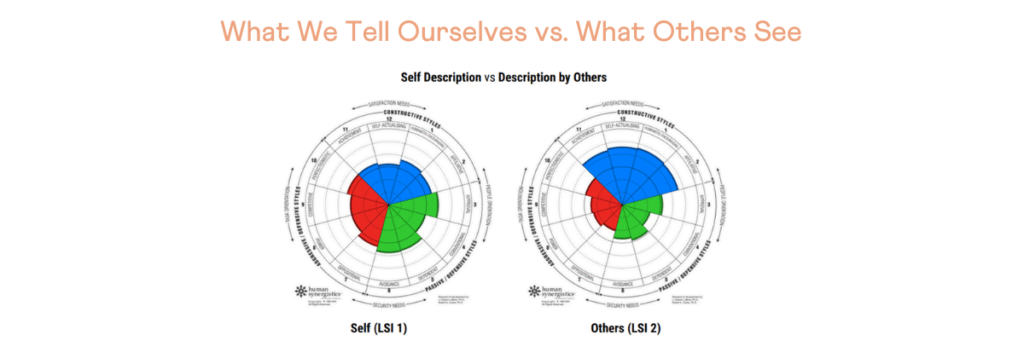
At the same time, wellbeing indicators such as stress management satisfaction lag population averages.
This gap between external capability and internal narrative is significant – akin to driving with the handbrake on – and affects:
- Visibility
- Use of voice
- Risk-taking
- Influence
- Strategic positioning
- Succession readiness
“Perhaps it’s time to hold those old internal stories up to the light, examine the evidence, weigh the trade-offs, and consider re-authoring a new story – one of confidence, stepping forward, leading, and owning expertise.”
If your organisation is serious about accelerating women into senior leadership, you cannot rely on structural reform and quotas alone.
You must invest in shifting internal capacity and external impact simultaneously – embedded in strategy and linked to your organisation’s purpose and priorities at every step.
The Compass Effect – Patterns Across Organisations
Dattner Group’s Flagship program for women and leadership, Compass, has evaluation data from organisations including University of New England (UNE), Quest Global and McCormick Foods Australia. Here, also, clear and consistent patterns emerge, repeating across sectors, industries and organisational contexts.

1. Self-awareness deepens and leadership identity strengthens
Participants across cohorts describe gaining clarity about purpose, values, internal triggers, and habitual patterns.
UNE participants reflected on increased insight into how they respond to challenges and greater capacity to pause and choose differently.
Quest Global participants described the program as deeply transformative, particularly in strengthening self-awareness and leadership identity.
This matters because leadership maturity begins with self-regulation. Without it, technical capability alone is insufficient.
2. Confidence and courageous communication increase
Compass participants reported increased confidence in how they communicate, influence, and set boundaries.
Quest Global participants highlighted growth in courage, self-worth, and willingness to stand up for themselves.
McCormick Compass alumnae reported increased presence and courage, alongside sharper influence grounded in values.
In commercial terms, this translates to:
- More constructive conflict
- Stronger decision conversations
- Reduced avoidance
- Clearer stakeholder management
- Higher leadership visibility
These are measurable business behaviours.
3. Conflict navigation and relational intelligence improve
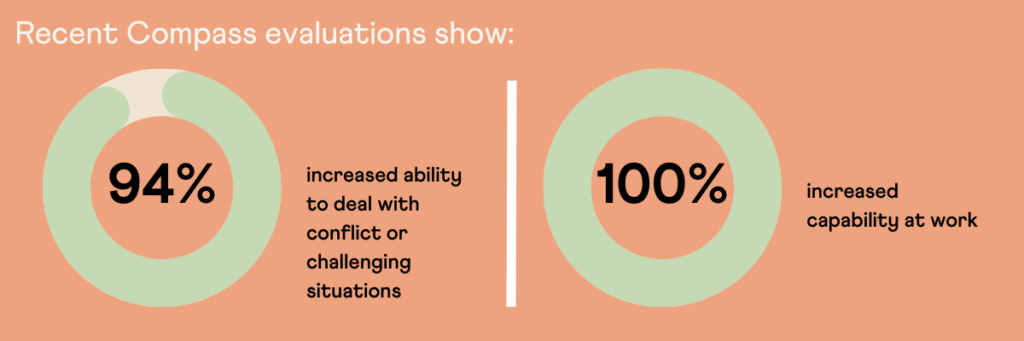
Participants describe actively using frameworks such as Above/Below the Line, the Drama Triangle, values mapping, and mindset tools in their teams. This is not theoretical learning. It shows up in how meetings are run, how feedback is delivered, and how tension is managed.
4. When supported, organisational ripple effects occur
McCormick Foods Australia has supported more than 30 women to participate in the Compass Flagship program and has invested in dedicated activation sessions for its Compass alumnae. These sessions are designed to embed program learning into McCormick’s organisational context and strategic priorities.
Their experience makes a crucial point: development alone is not enough. As one leader reflected, ”culture is the soil”.
When senior leaders and managers were brought into conversation alongside Compass participants, the organisation began addressing the enabling conditions that determine whether growth translates into impact:
- Psychological safety
- Autonomy
- Clarity of expectations
- Cultural permission to challenge
Quest Global’s evaluation similarly identifies the importance of embedding follow-through structures to sustain impact.
Compass participants describe sharing tools internally and already influencing team norms across 18 organisations represented.
When development is paired with organisational reinforcement, the impact scales.
Why This Is Best Business Practice
Investing in women’s leadership is a strategic choice that directly shapes organisational performance, resilience and long-term value.
As global performance research and Australian inclusion data consistently show, advancing women into positions of influence strengthens:
- Succession planning
- Decision quality
- Organisational adaptability
- Cultural health
- Retention of high-potential talent
- Leadership bench depth
When capable women are fully activated, organisations widen their field of vision. Decision-making improves. Risk is surfaced earlier. Innovation expands through more diverse perspectives and lived experience. Leadership conversations become richer, more constructive and better equipped to navigate complexity.
The cost of inaction shows up structurally, through:
- Talent leakage at mid and senior levels
- Under-leveraged capability
- Avoided conflict that erodes performance
- Cultural fatigue and disengagement
- Narrow leadership perspectives at the top
International Women’s Day should prompt reflection and review, an opportunity to examine whether your current approaches are delivering measurable shifts in leadership capability, confidence and cultural conditions. Or whether they are largely symbolic?
The Question for Senior Leaders
If you want:
- More women ready for executive responsibility
- Stronger cross-level influence
- Healthier team dynamics
- Reduced relational friction
- Greater retention of capable leaders
- Higher engagement and discretionary effort across teams
- Stronger commercial performance driven by better decisions
Then the question becomes:
Are your leadership systems creating the conditions required for that to happen?
Because capability does not accelerate without intentional activation.
Culture does not recalibrate by intent.
And pipelines do not self-correct.
Let’s Have the Strategic Conversation
If you are ready to:
- Sponsor women into Compass
- Run an internal Compass experience at scale
- Or strengthen the cultural conditions that allow women’s leadership to flourish
Let International Women’s Day be a reminder to put advancing women’s leadership on your strategic agenda this year, and let’s talk.