

A CEO said something to me recently that stuck.
He’d just read a line from one of our leadership capability studies: trust cannot be built by messaging alone. His response was, essentially, what does that even mean?
This is a leader for whom trust is deeply relational, built through values and storytelling, listening and observing and showing up the same way under pressure, through modelling the behaviour you’re asking of others. All of that is true. It’s also not the whole story.
The Gap Between How Leaders Rate Themselves and Each Other
Across our leadership capability work in local government, public health, higher education, retail, we regularly see a pattern in the research we do. Where it comes to enterprise leadership capability, individuals tend to rate their own capability reasonably well.
They believe they’re collaborating, protecting their people’s wellbeing, envisioning the future and doing their best to explain strategy and help people through change. Then they rate the leadership capability of the organisation around them, and the number drops. I’m doing fine, it’s everyone else who isn’t.
That read is wrong, or at least incomplete.
The gap isn’t really about other leaders falling short. It’s about visibility of behaviour and outcomes. If you sit at the executive table, you get to see (and contribute directly to) the reasoning behind a decision: the strategic intent, the trade-offs, the constraints nobody outside the room ever hears about. The rest of the organisation doesn’t get any of that.
They get the decision’s effect. A restructure, a reprioritised project, a changed deadline, a new reporting line. No context, just consequence.
Why Messaging Alone Doesn’t Build Trust
That same distortion repeats at every layer as decisions cascade down. A director translates an executive decision for their managers, who translate it again for team leaders, who translate it again for frontline staff, and at each handoff some of the reasoning drops out and some of the effect gets amplified.
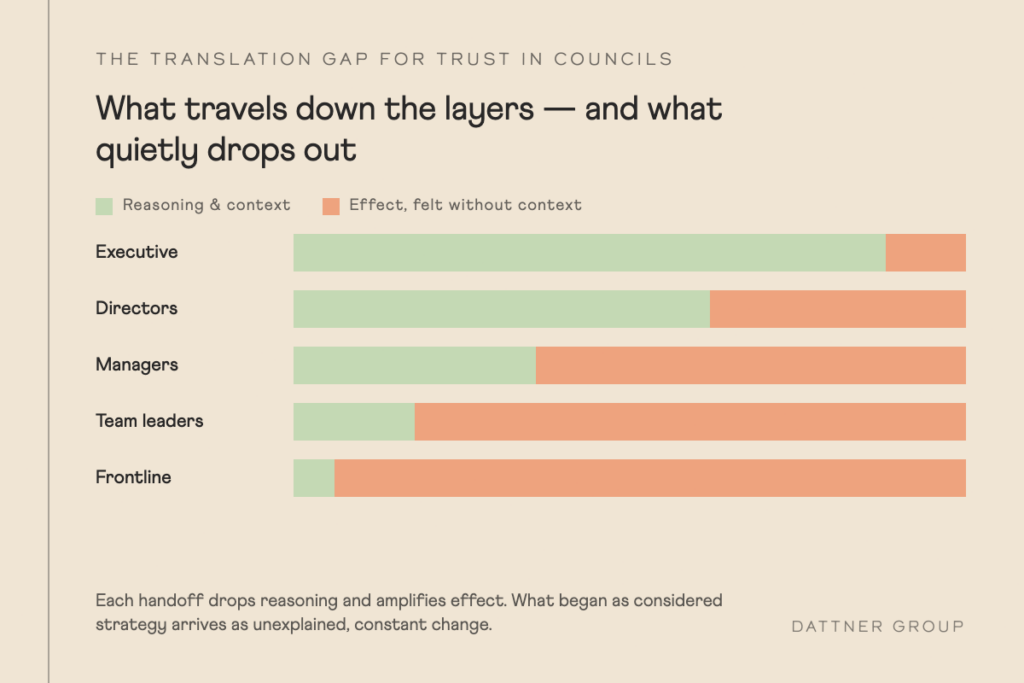
By the time it reaches the front line, what was a considered strategic response looks like unexplained, constant change.
This is where busyness acts as an amplifier. Translating a decision into something meaningful for the layer below takes time and attention: connecting it back to purpose, naming what’s staying the same as well as what’s changing, being honest about what you don’t yet know, making it safe for people to act when they may not have all the information they need. That’s exactly the work busyness crowds out.
When you’re moving from one urgent thing to the next, the default is to announce decisions rather than make sense of them for the people who have to live with them.
Hence why messaging alone doesn’t build trust. A well-worded email or a town hall or a comms plan from the comms team doesn’t fix a translation problem. If people can’t locate a decision inside a coherent story about where the organisation is headed and why, they don’t experience it as strategy. They experience it as instability. And instability triggers something specific: people start asking what this means for my job, my ability to do it well, my capacity to lead my own team through whatever’s coming next. That’s a threat response, and no amount of polished messaging resolves a threat response on its own.
Trust is the foundational factor that allows you to bring everyone above the line. It’s what allows a leader to challenge a plan honestly, have a genuinely difficult conversation, or ask a team to commit to a strategy before every detail is settled. Erode it, and every one of those gets harder, right when the environment demands more of them, not less.
An Organisational Condition, Not an Individual Failing
None of this is news to anyone who’s spent time in an executive team over the past few years. Councils (and, let’s face it, most organisations) are navigating funding pressure, community expectations, and workforce constraints that shift constantly and mostly sit outside any one leader’s control.
Reacting, adjusting, reprioritising is a reflection of the environment leaders are being asked to respond to – it’s not leadership capability on its own.
This means the translation work matters more than it used to, not less, and it’s usually the first thing to disappear when everyone’s stretched.
So the pattern we’re seeing isn’t really a story about some leaders performing and others not. It’s a story about an organisational condition: busy leaders at every layer, each convinced they’re doing their bit well, each unaware of how much sense-making has quietly stopped happening on their watch.
Multiply that gap down four or five layers and you get an organisation that no longer trusts its own direction, not because anyone lied, but because no one had time to explain.
A question we invite you to ponder ahead of your next planning cycle or leadership team meeting: if you were to ask anyone below you to explain, in their own words, why the last three decisions you made matter, would they be able to? If they can’t, that’s where the trust is leaking out.
Want to close the trust gap in your organisation? Dattner Group works with leadership teams to build the capability that turns decisions into shared understanding, not just announcements. Get in touch with Dattner Group to talk through what this could look like for your team.