

AI is everywhere and changing the way we work. I am hearing more and more Australian team leaders describe it as a change they can’t stop. The most common impact from AI implementation is a reduction in team numbers with the rationale, delivered from above: AI would absorb the work that their team were doing.
For some it is research assistants, creative designers, data programmers and for others it is admin support. On paper, it sounds efficient because AI will do more, but the reality for many is a demand to do more with less, dressed up as an upgrade.
I spoke to one leader who told me their initial reaction was to resist. Not loudly, but persistently: raising objections in every meeting, delaying rollout tasks, treating the change as something to be managed away rather than through. It’s tempting to read that as resistance to change. But the more interesting takeaway is to consider whether the leader’s discomfort was actually tracking something real?
It was. And the data backs up their instinct.
The workload argument doesn’t hold up
The pitch behind AI-driven restructuring is that the technology absorbs the work a support team used to do.
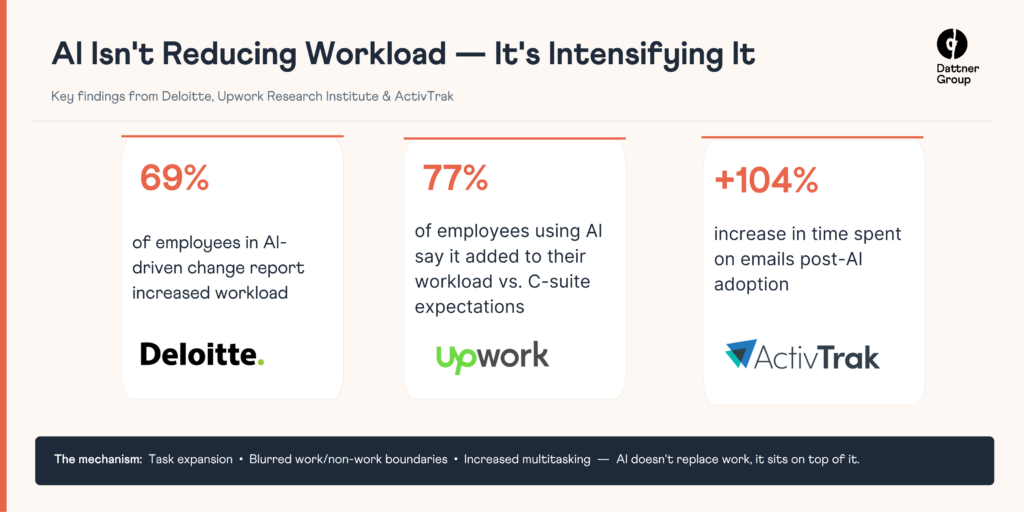
Deloitte’s most recent workforce research complicates that. Among employees going through significant AI-driven change, 69% report their workload has increased, not decreased, and 43% cite lack of time as the biggest barrier to adapting to the new tools.
A separate 2024 study by the Upwork Research Institute found a similar gap at the top: 96% of C-suite executives expected AI to lift productivity, but 77% of the employees using the tools said it had added to their workload instead.
Behavioural data tells the same story from a different angle. ActivTrak’s 2026 analysis of over 10,000 users, comparing behaviour before and after AI adoption, found that time spent on every measured work category went up. Emails rose 104%. Chat and messaging rose 145%. No category dropped. AI didn’t replace existing work. It sat on top of it.
Harvard Business Review researchers Aruna Ranganathan and Xingqi Maggie Ye put a name to the mechanism earlier this year in “AI Doesn’t Reduce Work — It Intensifies It”: task expansion, where AI’s ability to fill in gaps means more gets attempted; blurred boundaries between work and non-work; and more multitasking, as AI-assisted tasks get slotted into whatever space is left in the day.
This is not a training problem; it’s a structural one. So when a leader hears “the team is smaller because AI will help you” and feels that something doesn’t add up, they’re not being change-averse. They’re reading the situation correctly.
What opposition costs the person doing it
Here’s the complication. Being right about the problem and being effective in response to it are two different things, and the leader I was coaching had confused the two.
There’s a well-documented cost to staying in an oppositional stance. When a change registers as a threat, whether to workload, status, or autonomy, the brain’s threat-detection system activates and the prefrontal cortex, the part responsible for strategic thinking, planning, and judgement, becomes measurably less available. This isn’t a metaphor. It’s the mechanism behind entrenched resistance: people in a sustained “no” position often can’t see past the next objection to the larger pattern, and resistance tends to produce worse decisions, not better ones, the longer it runs.
The NeuroLeadership Institute’s 2025 revisiting of its SCARF framework adds a useful layer here. For years, certainty was the dominant driver of workplace threat response; people needed predictability to feel safe. That’s shifted. Fairness has moved to the top of the list. Which reframes what’s actually happening when a leader opposes a team reduction tied to an AI mandate: it may have less to do with the pace of change and more to do with a fairness read.
Is the org being straight about what this costs people, or is efficiency language covering for a decision that’s already been made regardless of input.
That distinction matters, because it changes what the leader should do with the discomfort. Naming a fairness concern is a strategic act. Staying oppositional because processing has stalled out is not.
The rollout you resist is often the one you helped design badly, by not showing up
There’s a further piece of research directly relevant to how this plays out at scale.
BetterUp research on how leaders talk about AI, drawing on a 2026 study led by Hancock and colleagues, examined what predicts “workslop”: low-effort, low-quality AI-generated output passed off as real work. The single biggest predictor wasn’t low psychological safety or weak AI skills. It was mandates.

Organisations that framed AI use as a compliance target, hit this adoption rate, demonstrate proficiency by quarter-end, saw employees outsource their thinking to the tool rather than engaging with it. Organisations that framed AI as something to explore and build judgement around got real experimentation instead.
The leader in front of me had a version of this decision available and didn’t see it. Opposing the rollout wholesale meant staying outside the conversation about how it got designed. But the research suggests that’s exactly the seat that matters. Leaders who bring a considered, specific critique into the process, rather than a blanket no delivered from the sidelines, are the ones positioned to shape whether their organisation ends up with a compliance-driven rollout that produces exactly the disengagement everyone fears, or one built with enough judgement in it to actually work.
The actual choice
None of this means the leader should have accepted the team reduction quietly. The workload data says their objection had grounds. But grounds for an objection aren’t the same as licence to stay stuck in one.
The choice isn’t between resisting AI and complying with it. It’s between staying below the line, where the threat response has taken the wheel and strategic thinking isn’t available, and getting back above it long enough to bring a real position into the room, one that names the fairness concern plainly and argues for a better-designed version of the change rather than no version at all.
Not every piece of AI-driven change deserves that grace. Some of it is genuinely poorly conceived, and leaders are right to say so. But saying so from a regulated, above-the-line place is a different act from opposing on reflex, and it’s the only version of the objection that has a chance of actually changing the outcome.
What would it take for you to bring your objection into the room instead of standing outside it?